Fable LoRa Remote Pump Controller / H1
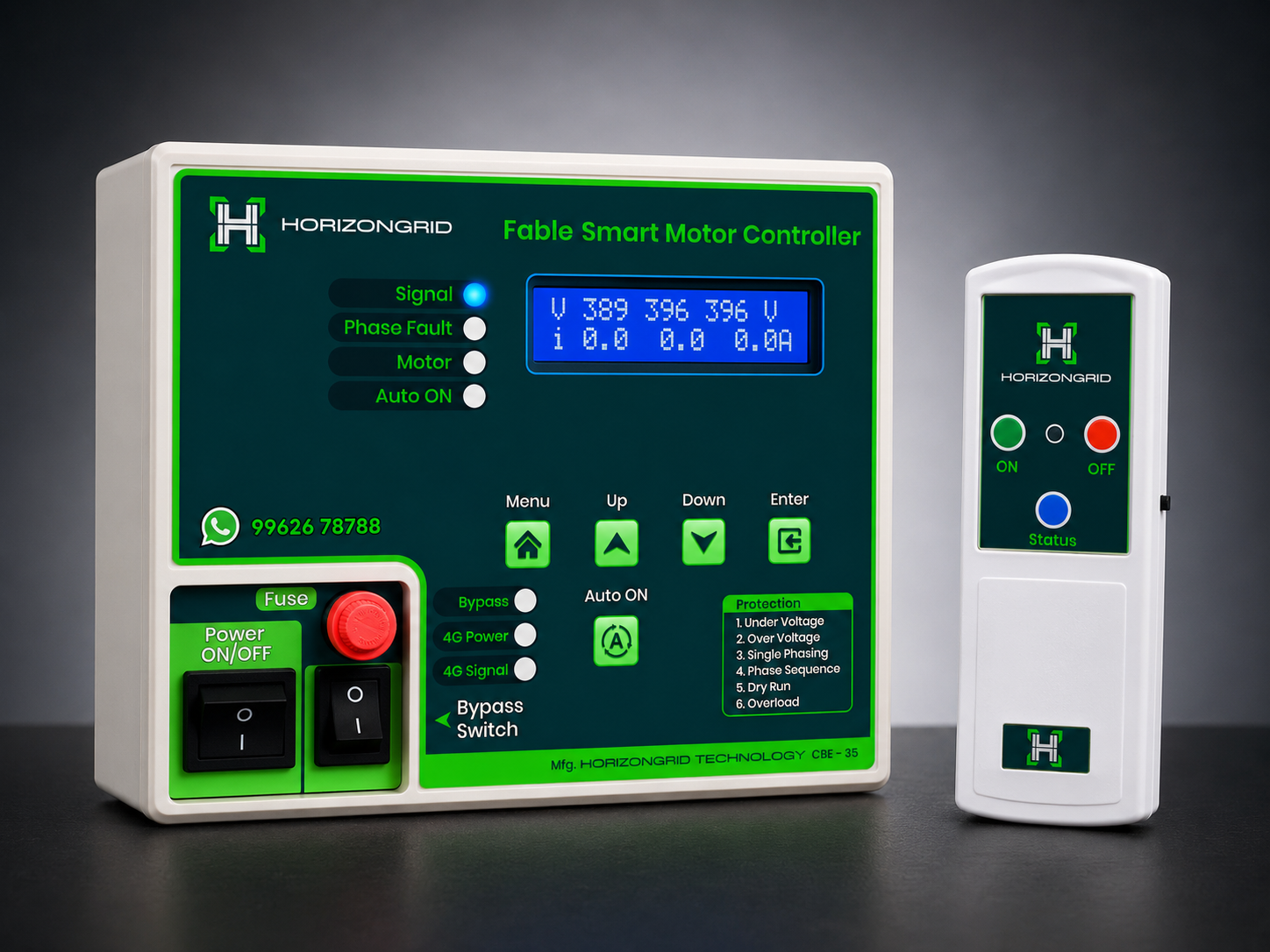
Three-phase pump controller with sub-GHz LoRa remote — start, stop, and monitor your pump from up to 4 km away, no internet required.
Smart starters, IoT hubs, and controllers engineered for the realities of the Indian farm — unstable grids, hard water, and 45 °C summers.
Five devices. One mesh. Designed in Coimbatore,
deployed across the subcontinent.
Three-phase pump controller with sub-GHz LoRa remote — start, stop, and monitor your pump from up to 4 km away, no internet required.
Three-phase starter for agricultural pumps with single-phasing prevention and IoT control.
Industrial 3Φ starter with auto-restart, scheduled irrigation and cloud telemetry for estates.
Field gateway that links every Horizon device to the Grid network, with 30-day local buffer.
Automatic tank fill control with overflow and dry-run lockout, paired with any Fable starter.
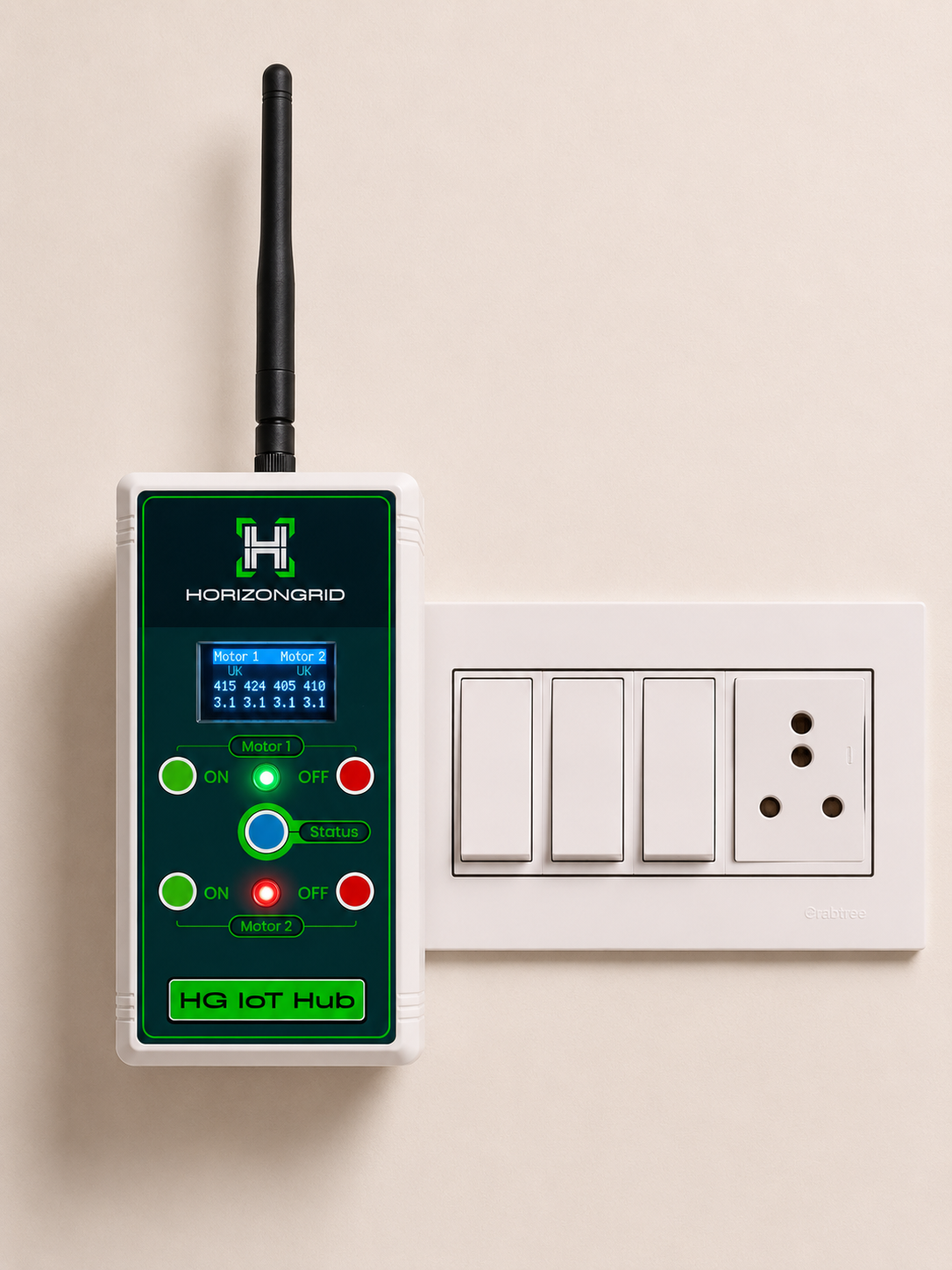
The HG IoT Hub is the spine of every HorizonGrid deployment — a sub-GHz LoRa gateway that links starters, controllers, and sensors across kilometres of farmland, then bridges the conversation to your phone, your SCADA, and your records.
IP65 enclosures with 6 kV surge protection rated for monsoon power.
All control loops run on-device. Cloud is for insight, not survival.
LoRa link from pump-house to homestead, even past concrete and groves.
MQTT and REST endpoints for SCADA, ERPNext, or your own tools.
Three-year warranty with field service across 184 districts.
Round-the-clock telemetry, alerts, and remote start/stop from your phone.
HorizonGrid was started in a borewell shed outside Pollachi, where a 7.5 HP submersible had burned out for the third monsoon in a row — not because the motor was weak, but because the grid that fed it was honest about how rural India delivers electricity.
We are an automation company that grew up downstream of the meter. Our work begins where the utility ends — at the panel, the starter, the float-switch — the thirty-rupee components that decide whether a season's irrigation goes through, or doesn't. Every device we ship is built to take a hit from a transformer four kilometres away and still log the event in plain English the next morning.
The architecture is deliberately boring.
Sense → decide → act → report, in that order, with the first
three loops closing on the device itself. A Fable starter does not need our cloud to know that
its motor is running dry; it needs 50 ms and a current-sense
resistor. The cloud is for the parts of the problem that genuinely benefit from hindsight —
schedules, trend analysis, the conversation with the farmer — and nothing else.
That discipline shows up as a single radio fabric across the line. Every Horizon device speaks LoRa at 865 MHz, mesh-routed through the IoT Hub, with MQTT bridges out to whatever stack the customer already runs. A water-level controller in the overhead tank can hand off a setpoint to a Fable H2 in the pump-house without either device touching the public internet — useful, given that the public internet, on most of our farms, is a guess.
We design the enclosures ourselves. We pour potting compound by hand on the first hundred
units of every revision. We test in 45 °C ambient because that
is what May feels like in Erode, not because a datasheet asked us to. The result is
unglamorous hardware that survives — IP65 housings, 6 kV surge clamps on every input,
and a service log that, thirty months in, reads more like a maintenance schedule than a parts
requisition.
Industrial design, in our reading, is the practice of taking promises seriously. A motor turns on, or it doesn't. A tank fills, or it floods. We are in the business of making sure the verb that follows the noun is the one the farmer was expecting — quietly, on time, season after season.
04:32
03:18
06:04
02:45
Talk to a field engineer about the right automation for your borewell, tank, or factory floor. We design the system around your panel — not the other way around.